Archaeological Techniques and
Research Center
FOR ALL ARCHAEOLOGY, BIOARCHAEOLOGY, OSTEOLOGY, FORENSICS, GEOPHYSICS AND EXPERIMENTAL PROJECTS, CHECK OUT OUR BRAND NEW WEBSITE:

A Soldier's Life - Excavation and Survey
July 14 - August 17, 2013
Tensions between Dacia and Rome always ran high. This came to a head in the beginning of the 2nd Century AD, when Trajan led two campaigns across the Danube to attack Dacia. The war was hard fought, and the Roman suffered heavy losses, but in the end, Trajan claimed Dacia for the Roman Empire, and returned to Rome to celebrate his victory. But what of the people of Dacia? Now that they were in the Roman Empire, how did their lives change? How did they interact with the Roman Army that was left behind? For a long time, these questions were ignored, but current archaeological work is looking to answer just these questions.
CARP (Cumidava Archaeological Research Project) is an international project seeking to better understand what is occurring in Dacia after the Roman conquest. By focusing on small scale interactions between Roman legions and Dacian civilians, CARP seeks to understand what it actually meant to the average person to now be subjected to Roman rule.
CARP is working in town of Rașnov, near the city of Brasov and nearby Bram Stocker’s Bran Castle, which was part of the Roman limes, a system of defensive forts that established the Roman Empire’s control over the area. These forts, called castra (castrum singular), are found throughout the contentious regions of the empire, and housed the Roman Legions. Through literary sources and material finds, the Roman name for this castrum is known to be Cumidava.
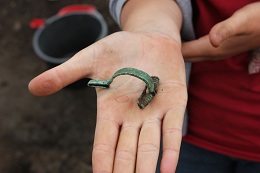
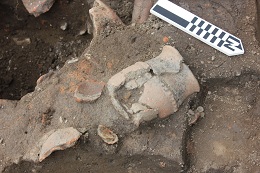
Castrum Cumidava was established during the Daco-Roman wars (102-106 A.D.), and was utilized for roughly 150 years by the Romans. This duration, along with evidence of several building episodes indicate that the fort was an important part of the Roman limes in present day Transylvania. The fort itself has been worked on for many years, but only recently has research begun on what was occurring just outside of the fort’s walls. This work began in 2010, the first year of CARP, which conducted an intensive survey of the area to locate the civilian settlement that would have supported the fort. As a result of that survey, a promising location has been found, as well as some additional areas that also seem to be tied to the fort, but in what capacity is still unclear. 2011 and 2012 found us working inside of the castrum, digging through the second phase of the barracks. Last summer, we uncovered the Roman road that transected the fort, and found many assorted artifacts, from Roman coins to what may turn out to be a cursed tablet, which was found directly under the road.
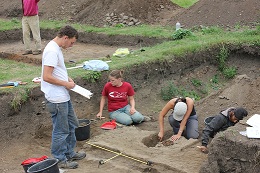
Building off of discoveries from the barracks area of Castrum Cumidava from the 2011 and 2012 seasons, we will be looking at how soldier would have used the space, and how the area shifted in use in the forts later stages. In addition, we will be conducting a excavations at points from the 2010 survey to firmly identify the civilian settlement, as well as find out the association of the other points of interest. The mix of established site along with exploratory work will offer a great deal of opportunity to experience different styles of archaeology, as well as dealing with research of forward thinking ideas about the past.
During the 2013 season will pick up where we left of be continuing excavations from the 2012 season. Building off of discoveries from the barracks area of Castrum Cumidava, we will be looking at how soldier would have used the space, and how the area shifted in use in the forts later stages. In addition, we will be conducting a few test excavations at points from the 2010 survey to firmly identify the civilian settlement, as well as find out the association of the other points of interest. The mix of established site along with exploratory work will offer a great deal of opportunity to experience different styles of archaeology, as well as dealing with research of forward thinking ideas about the past.