Archaeological Techniques and
Research Center
FOR ALL ARCHAEOLOGY, BIOARCHAEOLOGY, OSTEOLOGY, FORENSICS, GEOPHYSICS AND EXPERIMENTAL PROJECTS, CHECK OUT OUR BRAND NEW WEBSITE:

Iron Age Home
Iron Age Dacian Fortress and Settlement
Excavation and Survey
July 07 - August 10, 2013
NEW:
The Olt River valley in South-East Transylvania (Romania) has always been the gateway between the Transylvanian Plateau (hence the Pannonian Plains and therefore Europe) and the Danube Basin (and through the Balkans, Asia Minor and the Mediterranean Sea). Its importance is such that it has been continuously inhabited since early prehistoric times.
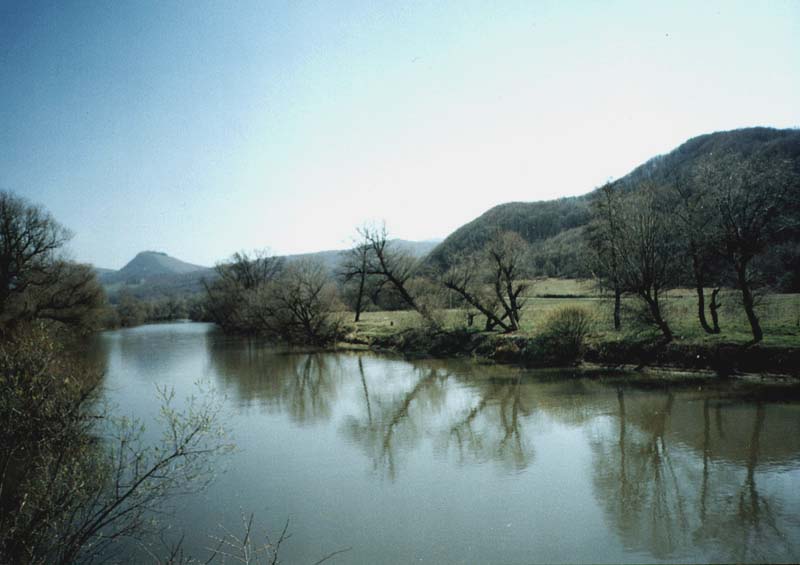
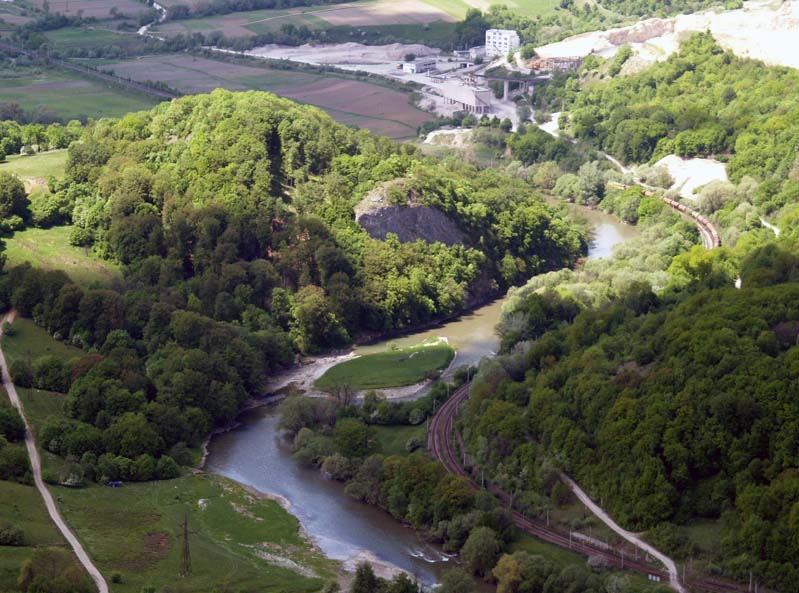
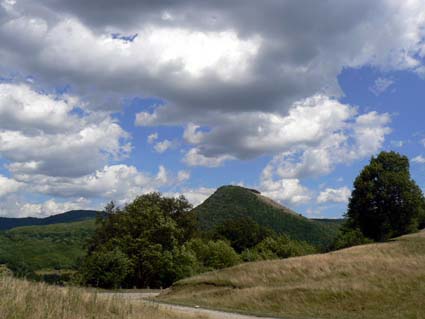
"Dacian" Landscapes: Racos and Surroundings
Half way between the medieval city of Sighisoara (the real Dracula’s birth place and an UNESCO Heritage Site) and Brasov (and the nearby Bram Stocker’s Bran Castle), a very elaborate system of Dacian strongholds, civilian settlements and religious centers has been located in the Racos de Jos area. Every hill top and most of the Olt River Basin is occupied by the remains of various Dacian Iron Age settlements. The complexity of the region has only been understood in the last few years when the excavations at Augustin, a great temple complex, have been finalized. The extent of the site, its relationships to other Dacian sites, quality and quantity of the material finds indicated that the Racos complex is one of the greatest La Tene (Late Iron Age) Dacian settlements in South-East Europe.
The site we are currently excavating is situated on a hill facing the Augustin Temple Complex, the Sacred Mountain, and is most likely associated with it. The trenches excavated over the past six years have exposed a rich and complex fortified urban center, destroyed by Emperor Trajan’s legions during the Daco-Roman wars (102-106AD). The magnitude of the destruction level testifies to the importance of the site both to the Dacians and the Romans.


Most of the fortified Dacian settlements in Transylvania have been emptied of their civilian element and only military presence was left to face the Romans. It is not the case for this region. A great number of civilian objects (complete ceramic vessels, jewelry, weaving implements, etc) has been found, proving that the region has not been evacuated as the Roman legions were advancing. Fighting was fierce for control of the region: human skeletons and weapons, both Dacian and Roman (some quite rare) have been found even inside the burned houses on the acropolis.
To our surprise, while searching for the extension of civilian within the fortified acropolis, we uncovered several Wietenberg (Middle Bronze Age) Culture houses, dating from ca. 1600BC. To our surprise, the interior of the rather poorly constructed buildings yielded extraordinary material: high end, very decorated ceramics, complete vessels, votive figurines and various replica of decorated chariots. The presence of these "votive shacks", very rich in exceptional artifacts point to the presence of a temple complex in the acropolis.
The 2013 season will be devoted to the exploration of the fortified acropolis of the Piatra Detunata site and locating the associated the necropolis, through excavation, test pits and phosphate surveys. Now that we have identified the gate structure, we will expose the central part of the fortification system in order to see how it relates to the civilian buildings of the acropolis and the rest of the military structures. At the same time, we are going to continue the excavation of the acropolis itself for the purpose of identifying the role that various constructions played in the urban Dacian fabric. Considering the extraordinarily rich and varied archaeological material recovered during 2008-2012 excavation seasons, 2013 offers remarkable promise.
Iron Age Home

Topographic Survey
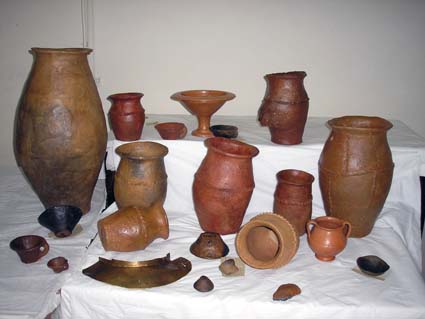
Dacian Ceramics - Racos, Brasov County
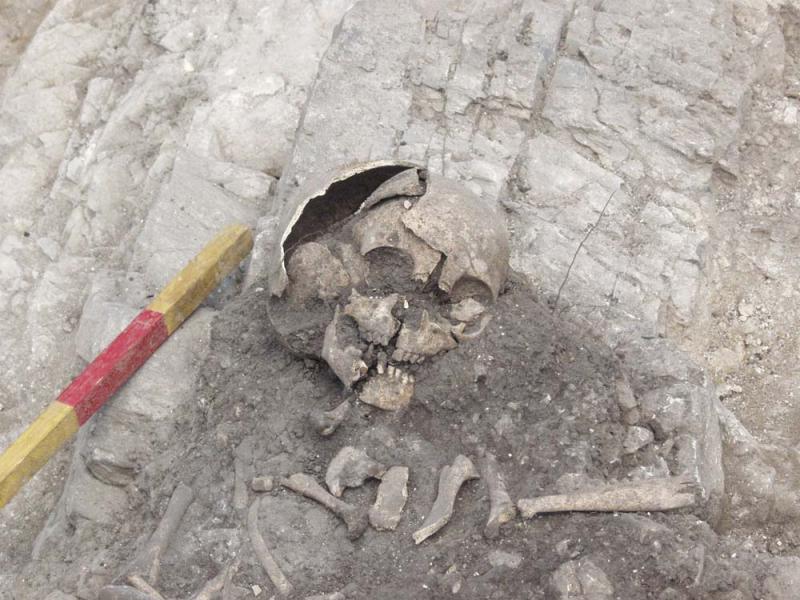 Dacian Sacrificial Child Grave - Hunedoara

Middle Bronze Age Cup - Racos
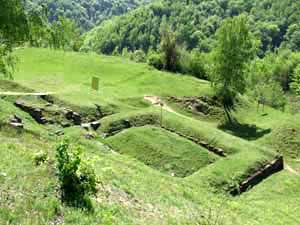 Fortification Tower - Costesti, Hunedoara County
